

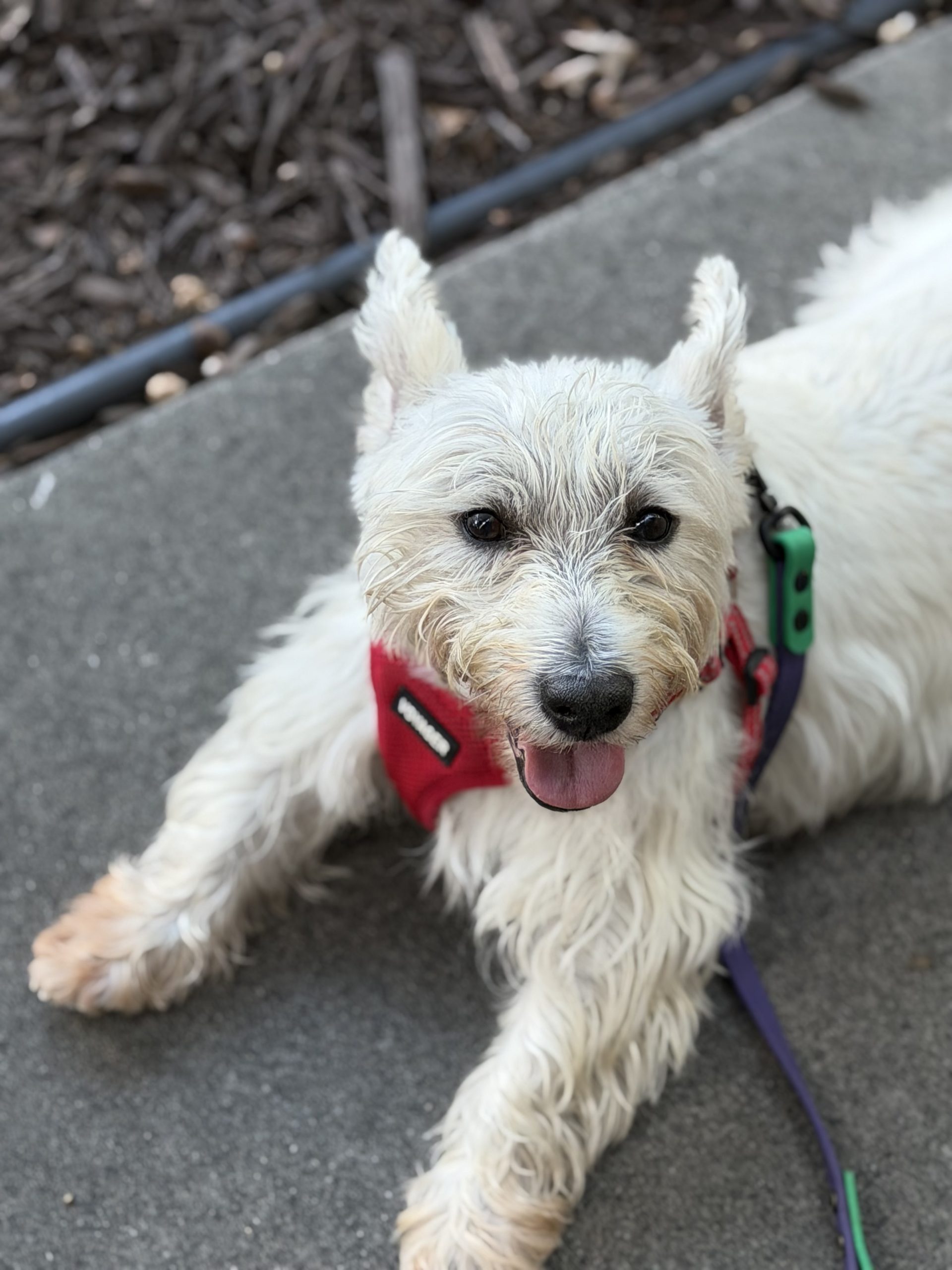
You are three blocks from home. Your dog is sniffing a familiar patch of grass. Then a dog you have never seen before comes around the corner with no leash and no person behind it.
Your stomach drops. You have about six seconds to decide what to do.
If you walk a dog in Atlanta, this has probably already happened to you. It happens on the Beltline, on the quiet streets of Ormewood Park and Adair Park, along Freedom Park Trail, and in the alleys behind Cabbagetown. Sometimes it is a dog that slipped out a front door in Virginia-Highland. Sometimes it is a gate a delivery driver left open in Kirkwood. Sometimes it is a person forty feet back calling out the words every dog parent has learned to distrust: “He’s friendly!”
We have walked dogs across this city for over six years. Our team has handled this exact moment more times than we can count. Here is what actually works, and what to do afterward, because the part that comes after matters more than most people realize.
First, what Atlanta’s leash law actually says
This is worth knowing, because most people are unclear on it.
In the Fulton County portion of Atlanta, which is most of the city, the ordinance is specific. A dog off its own property has to be “securely under leash,” and that leash can be no more than six feet long, held by someone able to control the dog. That is Atlanta Code of Ordinances section 18-124(b)(1). Violations can carry fines up to $1,000 and impoundment of the dog.
In the DeKalb portion of the city, the rule is looser in wording. The dog must be under control, leashed, at heel, or on the owner’s property, with no leash length specified.
Two practical takeaways. A retractable leash extended past six feet does not meet the Fulton standard. And the City of Atlanta does not run animal control at all. The counties do:
- Fulton County Animal Services: 404-613-0358
- DeKalb County Animal Services: 404-294-2996
Save both in your phone right now, before you need them.
The six seconds that matter most
When a loose dog is coming toward you, your body wants to do three things. Freeze, scream, or run. All three make it worse. Here is what to do instead.
Do not run. Running turns you into prey and turns a curious dog into a chasing dog. It also tells your own dog that this situation is an emergency, and your dog believes you.
Get big and get loud, once. A single, low, firm “GO HOME” or “OFF” stops a surprising number of loose dogs in their tracks. Low and sharp works. High and panicked does not. Say it once with your whole chest, hold your ground, and step toward the dog rather than away.
Put your body in the middle. Turn so you are standing between the loose dog and your dog, and angle your dog behind your legs. You are a wall. Most dogs will not push through a confident wall.
Keep your leash loose if you can. This one feels wrong, so it takes practice. When you yank the leash tight, tension travels straight down it into your dog’s body, and your dog reads it as confirmation that something bad is about to happen. A short leash held calmly, without a hard pull, keeps your dog’s body language softer, which makes the whole encounter less likely to escalate.
Scatter treats. This is the single most useful trick we teach, and almost nobody knows it. Take a handful of treats and toss them at the ground in front of the approaching dog, in a wide spray past its nose. A loose dog’s nose almost always beats its intentions. While it is hoovering up treats, you calmly walk your dog away in the other direction. No confrontation, no drama, no contact.
Do not stare, and do not reach. Direct eye contact reads as a challenge to a dog that is already worked up. And never put your hands between two dogs.
Walk away at an angle. Not backward, not in a straight line. Curve away calmly and keep moving. Use whatever is around you as a barrier if you need one: a parked car, a tree, a fence line, even your backpack held out to the side.
If the dogs actually make contact
Most encounters never get here. If yours does, keep this short list in mind.
Keep your hands out of it. Hands are how people get bitten, including by their own dog, who is not thinking clearly in that moment. Use something else: a bag, a jacket, a water bottle, anything you can put between them.
If another adult is with you, the safest separation is for each person to take one dog by the back legs and lift like a wheelbarrow, then move backward and apart in a circle. Never pull straight back on a dog that has hold of something.
Loud, sudden noise can break a moment of focus. So can a hard spray of water if a hose or bottle is right there.
Afterward, get the other person’s name and phone number, take a photo of the dog, and call county animal services at the number above. Do this even if your dog seems fine. A report creates a record, and if that same dog gets out again, the record is what protects the next dog and the next person.
Then have your veterinarian look at your dog even for small punctures. Bite wounds close over on the surface and cause problems underneath.
The part almost everyone skips
Here is what most articles leave out. Your dog does not shake this off in an hour.
After a frightening encounter, stress hormones stay elevated in a dog’s body for hours, and sometimes for days. What that looks like in real life is a dog who is jumpy at the door for the next week, who barks at a dog across the street that they used to ignore, or who plants their feet at the top of the driveway and does not want to go in the direction where it happened.
That is not your dog being difficult. That is your dog telling you they need a slower reintroduction.
This is where Vital Balance comes in, one of the six pillars in our THRIVE enrichment framework. Vital Balance is the decompression side of a dog’s routine: anxiety management, calm, and stress regulation. In the days after a scare, that means:
- A calmer route. Change the direction of the walk for a few days. Take the quiet residential blocks instead of the busy stretch where it happened.
- More sniffing, less distance. A twenty minute walk where your dog gets to sniff everything does more for a stressed dog than a fast forty minute walk. Sniffing lowers a dog’s heart rate. Covering ground does not.
- Frozen lick mats and slow feeders. Licking and chewing are self-soothing behaviors. A frozen lick mat after a hard walk is genuinely calming, not just a snack.
- A quiet, predictable rest space. Less traffic, fewer visitors, and a soft place to settle for a few days.
Then return to the block where it happened gradually, at a distance, with good things happening the whole time. Do not avoid it forever, and do not march your dog straight back into it the next morning either.
How we handle this on our walks
Every one of our team is trained for this before they ever hold a leash. They know the routes in the neighborhoods we serve, they know which blocks have a dog that gets out, and they carry pet correct spray, a slip lead and even treats specifically so they can scatter and walk away instead of standing and confronting.
If something happens on a visit, you hear about it from us that same day, in your daily report card, with photos and video. Not the next week. Not never. And the next visit gets adjusted: a calmer route, more decompression, a slower reintroduction, planned around what your dog actually needs that day rather than a route copied from another dog.
That is what we mean when we say more than just a dog walk. Six years in Atlanta, zero missed walks, and a team that knows your dog by name.
You do not have to figure this out alone
If your dog has had a scare recently, or if walks have started to feel stressful instead of good, we can help.
Start with a free 15-minute phone call. Nothing to sign, nothing to pay. Tell us about your dog, their energy, and what has been happening on your walks, and we will tell you honestly whether we are the right fit. If we are not, we will say so.
Most dogs start within a week. After your first visit you get a daily report card with photos and video, so you can see how your dog is actually doing from your desk. And every membership is backed by our Happy Home Guarantee: see a happier, more fulfilled dog in 30 days or your money back.
[Book your free 15-minute call]
Not ready to book? Take the free 2-minute THRIVE Profile quiz and find out what your dog is actually wired for.
[Take the THRIVE Profile quiz]
Praline’s Backyard Dog Services provides private walks with tailored enrichment, dog taxi, and membership-based dog care across Midtown, Old Fourth Ward, Grant Park, Inman Park, Virginia-Highland, Kirkwood, Ormewood Park, Cabbagetown, Adair Park, East Atlanta Village, and surrounding Atlanta neighborhoods.