

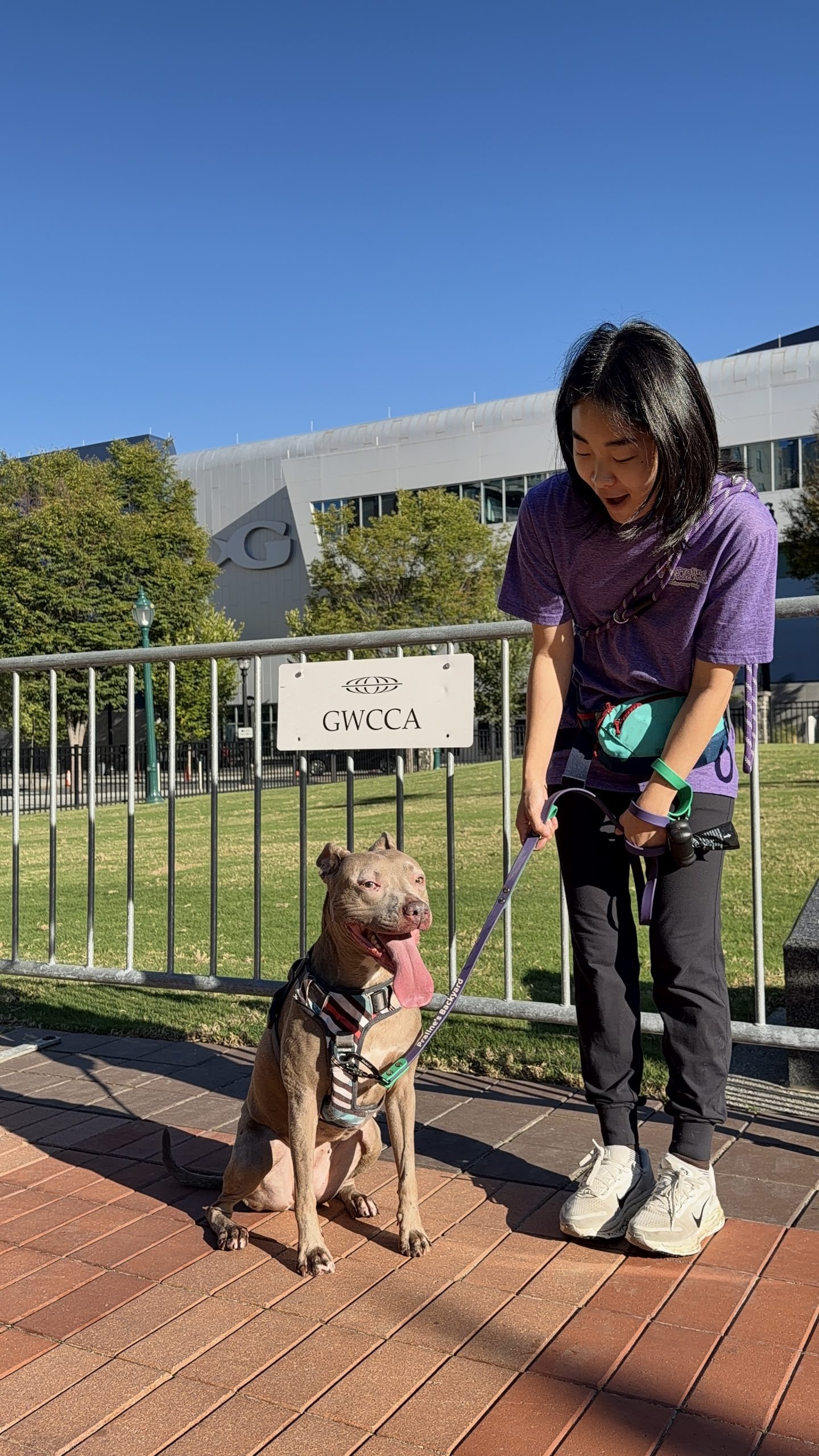
Praline’s Backyard exists because my dog didn’t fit daycare.
Praline is smart. She needed more than a quick walk and more than a room full of dogs. She needed to sniff, to move, to think, to solve something, and to be cared for by someone who saw who she actually was. Daycare wasn’t built for that dog. So I built something that was.
Here’s the thing I want to say early, because a lot of posts on this topic won’t: that doesn’t make daycare bad. It made daycare wrong for Praline. Some dogs walk into daycare like they own the place and come home glowing. If that’s your dog, keep going.
The question isn’t dog walker vs. doggie daycare. The question is which one your dog would pick, and your dog has been answering it every day. You just have to know what to look for.
Some dogs are made for daycare. Here’s how you know.
Daycare works beautifully for a certain dog: young, confident, social, and built for a full day of group play.
You can see it at the door. Your dog pulls toward the building, greets the staff, and disappears into the playroom without looking back. At pickup, they’re pleasantly worn down and settle at home within the hour. The next morning, they’re excited to go again.
If that’s your dog, this is the last paragraph you need. Pick a good daycare (there’s a checklist further down), keep an eye on the signs below, and enjoy it.
Signs your dog is telling you daycare isn’t it
Lora Shaw, a vice president at the Pet Palace daycare chain, told Newsweek what stress looks like at a daycare. Coming from someone who runs daycares, it’s worth reading twice:
- At drop-off: a tucked tail, hiding behind you, not wanting to go in.
- During the day: staying around the edges of the room, going into corners, not playing with the other dogs.
- After pickup: coming home stressed or overstimulated, or consistently withdrawn.
- Over time: avoiding the building altogether.
Then she said the line I’d put on a billboard: “Some dogs simply prefer being with their people, and that doesn’t mean they’re not a great dog.”
WebMD adds two more dogs who tend to struggle: dogs who guard toys or food, and dogs who don’t have the energy or the tolerance for group play. That second one covers a lot of perfectly wonderful dogs.
One more sign that’s easy to misread. A dog who comes home and collapses isn’t always a dog who had a great day. A tired dog isn’t always a happy dog. Sometimes tired means overstimulated, and the tell is what happens the next morning. A fulfilled dog wakes up settled. An overstimulated dog wakes up wired, or flat.
Dogs who usually do better one-on-one
After six years of this, here’s who I see thrive with private care instead of a group:
- Nervous or reactive dogs. A room full of dogs is the hardest possible place to feel safe.
- Senior dogs. They want a slow sniff, a soft bed, and their own house.
- Puppies before their vaccines are done. The American Veterinary Society of Animal Behavior says young puppies should skip places heavy with dogs of unknown vaccine status. We wrote a whole post on puppy schedulesfor that stage.
- Dogs recovering from surgery or an injury. Leash-only potty breaks and calm enrichment. Praline just lived this, and there’s a post about that too.
- Smart dogs. Praline’s whole category. A dog who needs to think gets bored in a room where the only activity is other dogs.
- Dogs who prefer their people. Shaw’s line again. Not every dog wants a social life. Some want a routine and one person they trust.
What a private walk with tailored enrichment actually is
This is the part that gets flattened into “a walk,” so let me be specific.
A private walk with tailored enrichment is a 40-minute, one-on-one visit designed around that specific dog on that specific day. Sniffing. Movement. Decompression. Food-based enrichment. Confidence building. Calm connection. Training reinforcement. The mix changes with the dog. A nervous dog gets a quiet route and a slow pace. A smart dog gets a scent game and a problem to solve.
Sniffing gets its own sentence because it’s the thing daycare can’t give a dog. In a study by Charlotte Duranton and Alexandra Horowitz published in Applied Animal Behaviour Science, dogs who spent two weeks doing nosework, hunting for hidden food, became measurably more optimistic than dogs who spent the same two weeks doing heelwork. The researchers put it down to two things: the dogs got to use their nose, and the dogs got to make choices.
That’s the line I come back to. Your dog does not just need to be tired. Your dog needs to feel fulfilled.
If you choose daycare, choose it like a pro
If your dog is a daycare dog, here’s what I’d ask before handing over a leash. This is also how I’d judge any daycare we drive a dog to:
- What’s the staff-to-dog ratio during play? The Dog Gurus, who train daycare operators, put active play at about 10 dogs per handler and call 15 a ceiling, not a target.
- When do dogs rest? You want real rest periods built into the day, with a set time and a quiet space.
- How are dogs grouped? Size, play style, and temperament, or whoever showed up.
- What happens when a dog is stressed? You want a specific answer. Where does that dog go, and who notices.
- Which vaccines do you require? And is there a waiting period after a shot.
- Can I stop by unannounced? WebMD suggests asking exactly that. A yes tells you a lot.
- Are you licensed? Georgia requires a kennel license for businesses that board or hold dogs for a fee. Ask to see it.
Good daycare is small-group, enrichment-based, properly staffed, and thoughtfully run. It exists in Atlanta. It’s worth finding.
The both-and answer nobody mentions
Here’s what most of these articles leave out: you’re allowed to do both.
A lot of dogs do best with two daycare days and three calm days. Some dogs need a quiet day after every daycare day. And plenty of dog parents love their daycare and hate the drive.
That’s why a visit with us can be a private walk with tailored enrichment, or a dog taxi ride, your choice each time. Your Canine Enrichment Specialist can drive your dog to daycare on Tuesday and give her a sniff walk on Wednesday. Let your dog decide, day by day.
The Atlanta part
The drive. Daycare means two trips a day, and in this city that’s the real cost. If your daycare is across the Connector from your office, you already know.
The heat. From late spring into fall, ask where the dogs are between noon and 3pm. Outdoor play yards in July are a question, not a feature.
The neighborhoods. The best enrichment in Atlanta is already outside your door: the shady blocks in Grant Park, the quiet streets in Kirkwood, the stretch of the BeltLine that’s empty at 11am. A dog who knows her own neighborhood has a home range, and that matters more than people think.
Dog walker vs. doggie daycare, side by side
| Doggie daycare | Private walk with tailored enrichment | |
|---|---|---|
| Best for | Confident, social dogs who love group play | Nervous, senior, recovering, smart, or people-focused dogs |
| The setting | A room of dogs | Your home and your neighborhood |
| Who sets the pace | The group | Your dog |
| Sniffing and choice | Limited | The whole point |
| Rest | Depends on the facility | Built in, on their own bed |
| The drive | You, twice a day | Nobody. We come to you |
| What you see after | A webcam, maybe | A report card with photos, video and GPS |
| Both? | Yes. We’ll drive them there | Yes. On the other days |
How we do it
Praline’s Backyard is a premium membership for Atlanta dog parents who want to never wonder if their dog is getting what they need. We care for dogs within 7 miles of Midtown, from Old Fourth Ward to West End, and your dog gets a trusted team assigned to them. Your Canine Enrichment Specialist (CES) is more than JUST a Dog Walker.
With our Balanced membership:
- Two visits are on the schedule every day. Add more whenever your dog needs them.
- Each visit is a private walk with tailored enrichment, or a dog taxi ride, your choice.
- Every visit ends with a report card: photos, video, and GPS.
- An Enrichment Toy of the Month, chosen for your dog from the THRIVE framework.
- A team that’s insured, bonded, background checked, and trained in pet first aid and CPR.
We open 10 new memberships a month, which is how every CES gets to know each dog by name. And with our Happy Home Guarantee, you can try Balanced for 30 days. If you’re not completely happy, we refund your first month in full.
Let your dog decide, for real
Take the free THRIVE Profile quiz. Two minutes, twelve questions, and you’ll know which of the six enrichment pillars your dog leans on most. That answer usually settles the daycare question on its own.
Then, if you want to talk it through, book your free 15-minute call. Tell us what your dog is like at daycare drop-off, and we’ll tell you honestly what we’d do.
Questions I get asked
Is daycare bad for dogs? No. It’s wrong for some dogs. The signs above will tell you which kind you have.
My dog seems fine at daycare. Should I switch? If your dog pulls toward the door and settles at home afterward, don’t switch. Add a sniff walk on the off days if you want to, but you don’t have a problem to solve.
Can my dog do daycare and private walks? Yes, and a lot of dogs should. A visit with us can be a dog taxi ride to daycare or a private walk with tailored enrichment, whichever your dog needs that day.
My dog doesn’t like other dogs. Will you take her? Private care is one dog at a time, in her own home, so there’s no group to manage. We’ll meet her at the in-person assessment and tell you honestly whether we’re the right fit.
What about puppies? Before the vaccine series is finished, keep them away from crowds of unknown dogs. We start puppies with in-home visits, and neighborhood walks begin once the vet clears them.
Do you serve my neighborhood? Check the service area. We cover Atlanta neighborhoods within 7 miles of Midtown.
Praline never went back to daycare. She got a business instead. Your dog doesn’t need that much. Your dog needs the right fit, and she’s been telling you what it is.